What you can see
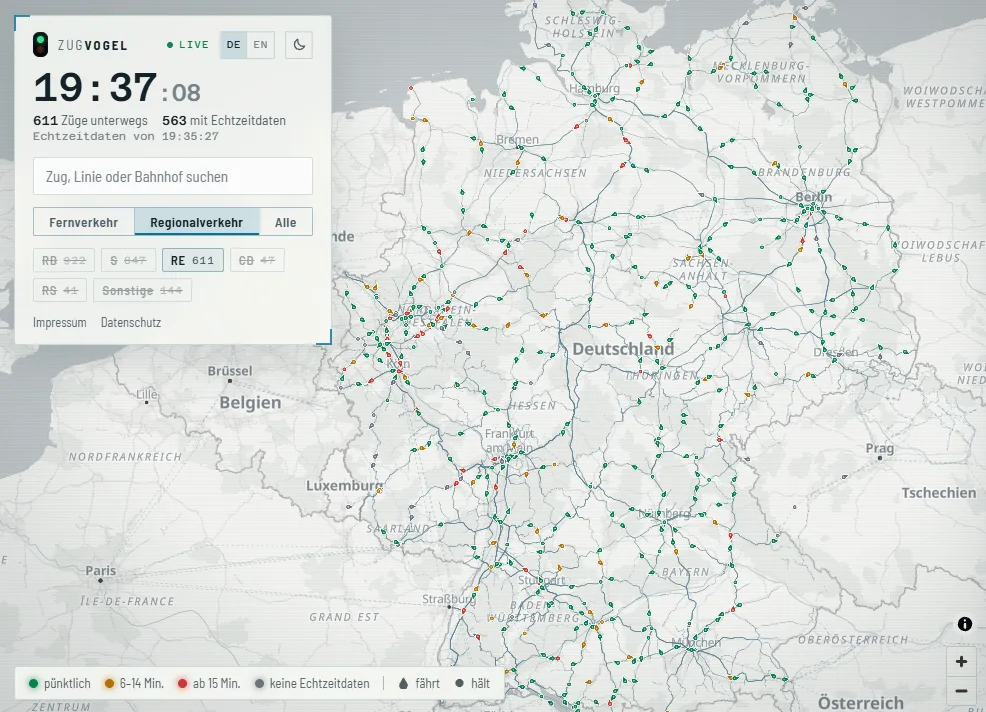
Zugvogel draws every train currently running in Germany on one map. You can switch between long-distance trains (ICE, IC, EC and others), regional trains (RE, RB, S-Bahn) or both. When you zoom in to a city, local transport appears as well: trams, U-Bahn and Stadtbahn, ferries and funiculars. Buses are not included.
Each train is coloured by its delay: on time, 6–14 minutes late, 15 minutes or more, or grey when there is no live data for it. Six minutes is Deutsche Bahn’s own threshold for punctuality.
- Click a train to see its route with the live delay at every stop.
- Click a station to see its departure board.
- Search for a train, a line or a station.
- Top 5 lists the most delayed trains and the busiest stations right now.
The map is available in German and English, with a light and a dark theme.
How the positions are estimated
Deutsche Bahn doesn’t publish where its trains actually are. What is public is the timetable and a realtime feed of delay predictions, cancellations and skipped stops. Zugvogel combines the two into a timeline for each train: when it arrives at and leaves every station. Your browser then moves the train along the track between those stations, slowing it into and out of stops, and keeps updating its position. A train shown at a station is between its predicted arrival and departure there.
Where the data comes from
- Timetable and live delays: DELFI e.V., via gtfs.de (GTFS and GTFS-RT).
- Tracks: OpenStreetMap contributors (ODbL), matched to the timetable with the open-source tool pfaedle and refreshed every week. Where that doesn’t find a track, Zugvogel uses DB InfraGO’s rail network (CC BY 4.0).
- Basemap: OpenFreeMap with OpenMapTiles, data © OpenStreetMap contributors.
Limitations
- Positions are estimates, not GPS. A train that is stuck between stations, or whose delay isn’t in the feed yet, is drawn where the timetable and predictions say it should be.
- Trains without live data move according to their timetable and are shown in grey.
- International trains are shown along their whole route, but outside Germany the track data is thinner, so some sections abroad are simplified or drawn as dashed straight lines.
- Trains that aren’t in the published timetable, such as short-notice extra or replacement trains, can’t be shown.